Video Summary
00:00
So I’m going to get right into it. What an event. I’m so excited to have a chance to be here with all of you. And, you know, it’s so great to have Keith here with us. And he’s a very good friend of ours for a lot of years and, man, he gets what I love about Keith. It was kind of like the same with Joe Ensor. It was the same with Dick Walker, was the same with Larry Wydell, was the same with Andy Young. It was the same with Richie Falcone. These guys always got me thinking about recruiting. I, I was, you know, I’m a technician, I’m a trainer guy, you know. And so Keith talked about, you don’t need to train. You know, I’m gonna tell you there are some different ways to train.
00:41
And the best way to train is in the field with somebody watching you. And the second best way to train is drill for skill, where people actually are said you, here’s your presentation. Stand up in front of the room and give it. It’s called drill for. It’s an amazing way to train. And we’ve trained that way. And you know, I’ve had this amazing kind of run here for the last year. The last few months have been crazy. We went to, we took the grandkids to England. My daughter in law is from London. She hadn’t been there since she’s nine. And so went to England with the grandkids and we spent 10 days in England. Then we came back and Patty had already planned a vacation to France. So then went to France for 18 days.
01:26
And so for 20, you know, 28 days in the last two months, I was in Europe and I found out I love to work, I love to vacation, I love to work, I love to golf, and I love to speak English. I like to talk. And so England I loved because I could talk to people. France, I was like, whoa, what is going on here? Like, so if you are not from the United States and English is your second language, I have a new understanding of what you deal with, okay? And so I appreciate you very much. But when we came back, we moved our home. We had a home at the beach. We had a home in Philly, we had an apartment. We have a home in Florida. Kind of like Keith, he has five, we had three.
02:14
I couldn’t keep track of anything. I didn’t know where clothes were, I didn’t know where shirts were. This rich people’s problems don’t, don’t feel bad for me. So we ended up selling the home down the beach because weren’t there that much. We bought a beautiful home outside of Philadelphia in Wayne, Penn. Your King of Prussia. It’s a dream home for us. We now have Florida and that. And over the last 12 days, that’s all we’ve been doing is moving. So I am now ready to talk some English to some people who want to learn Primerica. Are you all ready to learn some Primerica stuff?
02:46
So I started thinking to myself, you know, if I was brand new, now I’m going to go very fast and then I’m going to spend as much time as I can at the end on something called indexed universal life. And I’m going to give you a very basic training on it because it seems to be rearing its ugly head. It’s actually the blessing in disguise. The crusade is back in Primerica. You know, when I started in the business, everybody had whole life, then they had universal life and agents were out there selling it. You didn’t have social media, but man, they were on it. And we got to battle them every day. We got to battle those guys face to, you know, we’d go in and replace their business.
03:22
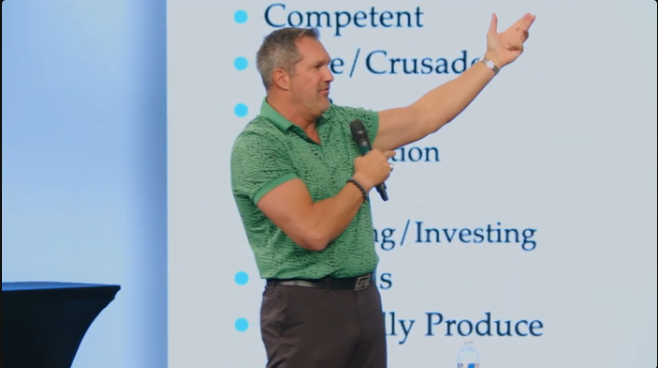
They’d come back and want to fight us, you know, and they’d tell us why were ripping people off. And, you know, you win at the kitchen table. I always said, you win at the kitchen table. In our business, you win at the kitchen table, you win with the client, you win with doing the right thing for people. And I started looking at, well, what if I was like right now start in the business and I wanted to learn some basic stuff, what would those things be? And so I put a couple slides together to simplify what it would be.
03:50
And I want to say this as politely as I can, but until you’re a complete fanatic about presenting, until you’re a fanatic about communicating our message, until you’re a fanatic about simplification of the message, until you become completely obsessed with that, I don’t know that anything great can happen for you here. In other words, some of you are listening to music in your car. I think there was probably a 15 year period that all I did was listen to audios. All I did was listen to a. When I started in the business, I got an audio presentation and I listened to that thing over and over and over again. And then I got a second person who did it. I listened to that over and over again.
04:36
Then I got out in the field like Keith talked about and I practiced it and I found out what worked and what didn’t work. But I was so good at the presentation that I never had to focus on the presentation. I could focus on the people. That’s the reason you work on your presentation so that you could be present with people so you can listen to what they want, so you can find out what they need. And so what are the slides that I think best communicate quickly to people so very in a very simple way where you can now not only communicate with the person who’s a potential client and or recruit, but your new recruit that you’re training actually believes they could do it. They actually believe they could do it. So here’s the first one.
05:20
So I think I’ve got the ability to do this. Here, here’s the first one. First slide. I think you have to do that. You now you need to internalize these things. Now I’m not going to train on this today. This would be an hour training. We’re not going to do that. But look at our mission statement to help families earn more income, become probably protected, debt free and financially independent. You’ve all heard that? Yes. Who would be interested in earning more income, properly protecting their loved ones, becoming debt free and having enough money someday where they never have to work? Who would be interested in that? See, until you can ask the question where you already know the answer in advance, I mean, if somebody gives me the wrong answer to that, I’m leaving. Okay. The theory of decreasing responsibility.
06:05
If you had one slide to explain what we do from a product standpoint, from a services standpoint, one of the key said is our product is the business opportunity, insurance and investments and mortgages and all the things we do, those are our services. So I’ve always focused on distribution. But I wanted to get really good at theory decreasing responsibility. I’m not going to go through it with you. Here’s what it basically says. Rent a pile of money until you build your own. That’s what it says. See, people ask you all, if someone says, well, how much insurance do I need? Well, the answer to that question is what would your family need a month if you died? If they say, oh, they need 3,000amonth, I said, is that the minimum they would need or would they need more?
06:53
Is that the minimum or would they need less? No. 3,000, well that’s 36,000 a year. Well, if you had 360 grand of money and you died, they could take that money and generate from that 36,000 a year. Yes. You all with me? If it was in a box under the house, it would last for 10 years. If it got 10%, it would last forever. And if it got 5%, it would last for 20 years. Very, very simple to rent a pile. It’s called low cost term insurance. Then save and accumulate money. So someday when the kids are grown and gone, you don’t need insurance because you’ve got money. So if you had 500,000 or a million dollars and no insurance and you died, what would the family get? Do they care where it comes from? Over and over. And I’ve asked that question for.
07:44
I’ve been here 40, this is my 46th year. I learned these questions when I was 23. It seems kind of silly, but the basic thing to win here is find out what works and do it over and over and over. That’s theory. All right, let’s look at the next one. Rule of 72. Not going to go through the Rule 72 with you. I’m going to go through the end of it with you. So the rule of 72, we all understand how it works. If you don’t know how it works, write down. I need to find out how the Rule 72 works. I’m going to assume you all know, but here’s what the real questions at the Rule 72. How do you win a game if you don’t know the rules? How about this next question?
08:24
Who would benefit by learning this basic rule called the Rule 72? Who would benefit? That’s called a referral hit. They’re going to say everybody. Yes. That’s why I’m going to ask you to introduce me to people you care about. How about this next one? Shouldn’t we have learned this in school? And without you introducing us to friends and family, when will they learn this? I want all of you to realize that referrals are part of our business. There are client referrals and there are recruit referrals. But you’re not going to get recruit referrals unless people see that you bring value that you actually can deliver at the kitchen table. Here’s another one. Which program would you want? Not gonna go through it again. We got the cash value on the left, and on the right side we got buy term and invest the difference.
09:02
Let me just say this about the insurance industry real quick. And I have, this is my basic conversation I have over and over with people every Single day. What’s the goal of a life insurance company? What’s the goal? Make money. Can you all repeat that back? What’s their goal? That’s what businesses do. So when you buy a policy, like on the left, where it’s got a face amount and it’s got a cash value built up, and you send them your premium, in this case, you sent them $251 when it gets to the home office, to that company, this policy has insurance and savings together. When it gets to the home office, whether it’s iul ul whole life, when it gets to there, when the money gets there, what do they do with it? What was their goal, by the way?
09:54
What do they do with the money? Here’s what they do with it. They pull enough out of the premium to cover the cost if you die. It’s called mortality expense. It’s called term insurance. They buy term insurance. The rest of the money they invest in, like stocks and bonds and government securities and real estate and cash. Like that. Like. What’s that sound like? What’s that sound like? A mutual fund, a diversified portfolio called a mutual fund. So the company’s goal was what? And what do they do with the. Now they sold you on this great plan where you save money and you can’t lose money and you could be your own banker and you could borrow and you could retire and if you don’t have to die to win and. And it’s permanent and they sell you on all that. They make it.
10:47
Oh, they make it sound good. How many of you ever been on TikTok or on Instagram and seen something that’s looked pretty good? Looked pretty good? Any of you have said you’re not on there, then why? They make it sound good, but the bottom line is their goal is to make money. What do they do with our money when we give it to them? They buy term and invest the difference. With the goal of what? So how are they going to sell you on this plan? And it’s going to better than what they’re doing? If their goal is to make money, they’re just cut them out and you make the money. You all with me? And I have three minutes. I think I got. Wait, let’s see. Let’s see. What? How about this other one? Here we go. How about this? Financial house?
11:26
See, these are the basic little slides that I. Financial house. Here’s how you build a strong financial game plan. You start with the foundation. You get a plan to get out of debt. You have an emergency fund you have a. Will you save money to be wealthy someday? Maybe send kids to college. Right. Basic financial house. On a scale of 1 to 10. 10. Be nice. How would you rate your desire to be financially independent? Probably protected. Definitely financially independent. How many of you get like number. When you say on a scale of 1 to 10 being the highest, how would you rate your desire to become properly protected? Debt free, properly protected and financially independent. What do they say? They say 10, they say 8, they say 7, they say 12, they say 15. Someone says 3.
12:09
You know, I would try to get some referrals and leave. That’s what I would do. How about this next one? Now’s the fun stuff. Cash flow quadrant. Not going to go through it with you, but there’s four ways to make money. Two of them require you to go to work. For you to spend your time working to earn money. It’s called employee and self employed. No work. No what? Okay, that’s called active. At work you have to go to work. How about these other two? Business owner, investor. You build a business that pays you when you’re not there. I was in Europe. You know, quite honestly, this business is crazy because when you build it right, you got people like we’ve got. I mean I have just an amazing people in our business. I mean just.
12:57
We just saw Rezi and we got Tesla, right? And we got Charlemagne. I just couldn’t be happier. And I got Thomas and I’ve got Patrick, right. I’ve got John Connor over and I’ve got Kent and I’ve got Dorie and I don’t want to leave anybody out. But I mean we have Merlene. You saw Merlene. And it goes on. And Junon now getting her. When you have a team like that, you can’t lose. It’s impossible to lose. They keep sending you the money. Active. Active. Active or passive. Which two ways to. Do you want to have to go to work to get paid or would you like to build something that pays you when you don’t work? Raise your hand if you’d like to get paid when you don’t work. It’s okay, don’t feel bad.
13:38
I know some of you are trained that there’s something wrong with that. And last but not least, and I’ve got like 50 seconds to do this, I’m going to explain to you a very simple. Now you’re not going to get it all, but here’s what you need to know when it comes to universal life, variable life and indexed universal life. There’s a Couple pieces of the puzzle that you need to understand and it’s easy to understand them when you get the policies. The way to really learn about what’s wrong with these products is get the contracts. And today you could take the contract, you could take a picture of the pages, you could go to ChatGPT, you could load it in and say, please tell me what’s wrong with this. Please explain to me the fees and expenses affiliated with it.
14:31
ChatGPT will take the policy and Ally Chat when you’re done, it’ll say, would you like me to make a PowerPoint of that for you? Well, yes I would. But basically you got premiums being sent to the company. See that faucet at the top? That’s the premiums and the money’s dropping into the bucket. See the bucket? The bucket’s the accumulation account. That’s where they’re either going to. If it’s universal life, it’s like Treasuries. If it’s a variable life, it’s like mutual funds. If it’s indexed, it’s an index tied to an index, but it’s going into an account. At the end of the year the company tells you what your account made, okay? That’s what’s going on. You’re paying money in. It gets to the bottom of the bucket. And every single month, see the far right there?
15:21
Every, every single month they come and pull enough out of there to buy insurance for a month term insurance. That’s how it works now. It’s got surrender fees, it’s got option A and B, it’s got all that. But here’s the basics, here’s what you need. Oh, sorry, go back. One last thing. I just want you to hear, see and hear and understand this. When we added up all the fees, so I get the policy, I go to chat. What’s going on here? What are the fees? It gives you the fees, just have them come out of the faucet. And that guy paid 750amonth. That’s what they were paying. And how much got into the bucket? How much got into the bucket? See that? 652. Well when you calculate that’s a 13% sales charge. 13% of your money never got into the savings account.
16:09
I don’t care what they tell you, it’s making 13% of the money’s already gone. Then on top of it they have to pull money out to buy the insurance and see the right side. What’s happening to the price as you get older what happens goes up, up, up. So you’re buying term insurance. It gets more expensive. You’re paying 13% fees. That’s what’s going on with the plan. All you have to do to beat that thing is run what we call basic illustration. And if you look at our term insurance and our investment options and the choices people are given, we win every time. Every single time. Why? Because the insurance company’s goal is to, what, Make a profit? What do they do with our money? They buy terminvest the difference with the goal of making a profit.
16:56
Then they sell you on this fangled thing that no one understands, no one can comprehend. It sounds wonderful. And it’s all designed to get our money in their pocket so they could build more towers. Well, enough’s enough, y’. All. Let’s go kick some major butt.